
AMIRI Jeans: All Fit and Motif, Explained
As a Los Angeles house, AMIRI expanded everything else out of its denim. Mike Amiri set the label up in his hometown, with two dates in play: the about page says 2014, and the earliest contemporaneous press release, from December 2014, says 2013 and calls the launch a partnership with the retailer Maxfield. The debut was an exclusive capsule at that store either way, and the jeans that carried it were distressed by hand and visibly repaired. The operative verb is still repair, because denim is worn down deliberately and rebuilt with contrast material rather than invisibly patched. Price and naming both follow from that single idea, and the naming looks more complicated from outside than it really is. Anyone who types amiri jeans into a search box usually wants to tell the shapes apart from the surfaces. What follows separates the two, then goes fit by fit.
Fits and treatments make up two distinct lists
Two groups, behaving differently, is what the names in this line split into. The first group is fits: MX1, MX2, Stack, Thrasher, Shotgun, Carpenter, MA Fit and Baggy are cuts and constructions. Group two is the treatments, where Bandana, Crystal, Stud, Eagle, Aloha and Monogram are motifs applied on top of those cuts. A treatment travels amiri mx2 across several fits in a single season, which is why an MX1 Bandana and a Crystal Thrasher can sit on one rail. Coverage of this brand goes wrong most often by treating a Bandana jean as a peer of the MX1. Keep the two lists apart and the assortment reduces to a handful of shapes wearing a rotating set of finishes.
MX1
The signature of the house denim is the MX1. In official copy it is a skinny-fit jean in Italian stretch denim with classic five-pocket styling, hand-distressed and repaired with pleated leather. Ovine leather is the listed contrast, and those panels occupy the abraded zones at knee and thigh rather than decorating them from above. The composition runs 92 percent cotton, 6 percent elastomultiester and 2 percent elastane; it sits in the Core Collection; and it is made in the USA. The observed market price is $1,090, putting it at the top of the standard denim band. If you try one pair only, this is the reference the rest of the category gets measured against.
Stack
Stack is the entry point into core denim at an observed $750. The official description is a Stack jean in Italian stretch denim, skinny and five-pocket, carrying an intentional overdye treatment. Its defining feature is not distressing but length, because an engineered long inseam lets the leg concertina at the ankle over a boot or over amiri sneakers. The pooling is design, not a tailoring fault, and it should never trigger a size change. Composition is the same as the MX1, and the origin is likewise the USA. For a first pair it is the quietest thing in the range.
Thrasher
Thrasher is where hand-distressing shows most plainly. A skinny, mid-rise cut in hand-worked Italian stretch denim, it comes with retailer copy describing the abrasion as mimicking what Mike Amiri applied to jeans in the nineties. What separates it from the MX1 is the absence of a structured leather panel, since the repair happens through abrasion and rebuilt fabric rather than an inserted material. Distribution is the broadest of any cut here as well, with the jean appearing at department stores and specialists at the same time. Market variants run to Crystal Thrasher, Eagle Thrasher, Leather Thrasher and Hollywood Thrasher. Choose it when you want the wear without the hardware.
Shotgun
Of the current shapes, Shotgun is the most aggressive. The house frames its frayed holes as a continuation of an exploration of material distortion through a specialised battle-worn treatment. In practice that means shot-through openings with sanded edges set into faded Italian denim, so it reads as impact rather than fade. It is made in straight-leg and skinny versions, and some carry the extended inseam that lets the leg stack. There is a Crystal Shotgun, which places embellishment directly against destruction on a single garment. Reach for this pair when the treatment rather than the silhouette is the point.
MX2 and MX3
MX2 is beyond doubt a real name, though neither its status nor its definition is straightforward. Collection pages for MX2 have existed on the brand’s site, and they returned no live products when checked in 2026, while off-price retail and resale still carry it in quantity. So it registers as archive-leaning instead of a current headline cut. There is also disagreement between sources about what defines it: some describe bandana or contrast denim inserts in place of leather, while retailer copy leans toward ribbed leather patches, zippered knee vents and outseam zips. The honest summary is that MX2 is the zip-detailed sibling of the MX1 and that circulating descriptions do not agree. MX3 appears on the brand’s site only as a women’s Baggy MX3 at an observed $990, a no-waistband motocross-inspired hybrid, so that repeated idea of a numbered men’s ladder has no basis.
Carpenter, Baggy and MA Fit
Not everything here is skinny, and this group is where to send anyone who dislikes a narrow leg. Carpenter, Faded Carpenter and Carpenter Repaired Baggy bring workwear detailing and a far more generous line. Volume goes further again with Washed Baggy and Baggy Cargo, and the MA Fit jean sits between the poles as a modern regular cut. Other real names in the same territory include Repaired Boot Cut, Monogram Straight Leg, Track Jean and the Patchwork and Art Patch constructions. As a group they occupy the same broad band as the skinny cuts, and the most heavily reconstructed pairs go above it. These roomier shapes have quietly become the more forgiving half of the category.
The treatments that move across the fits
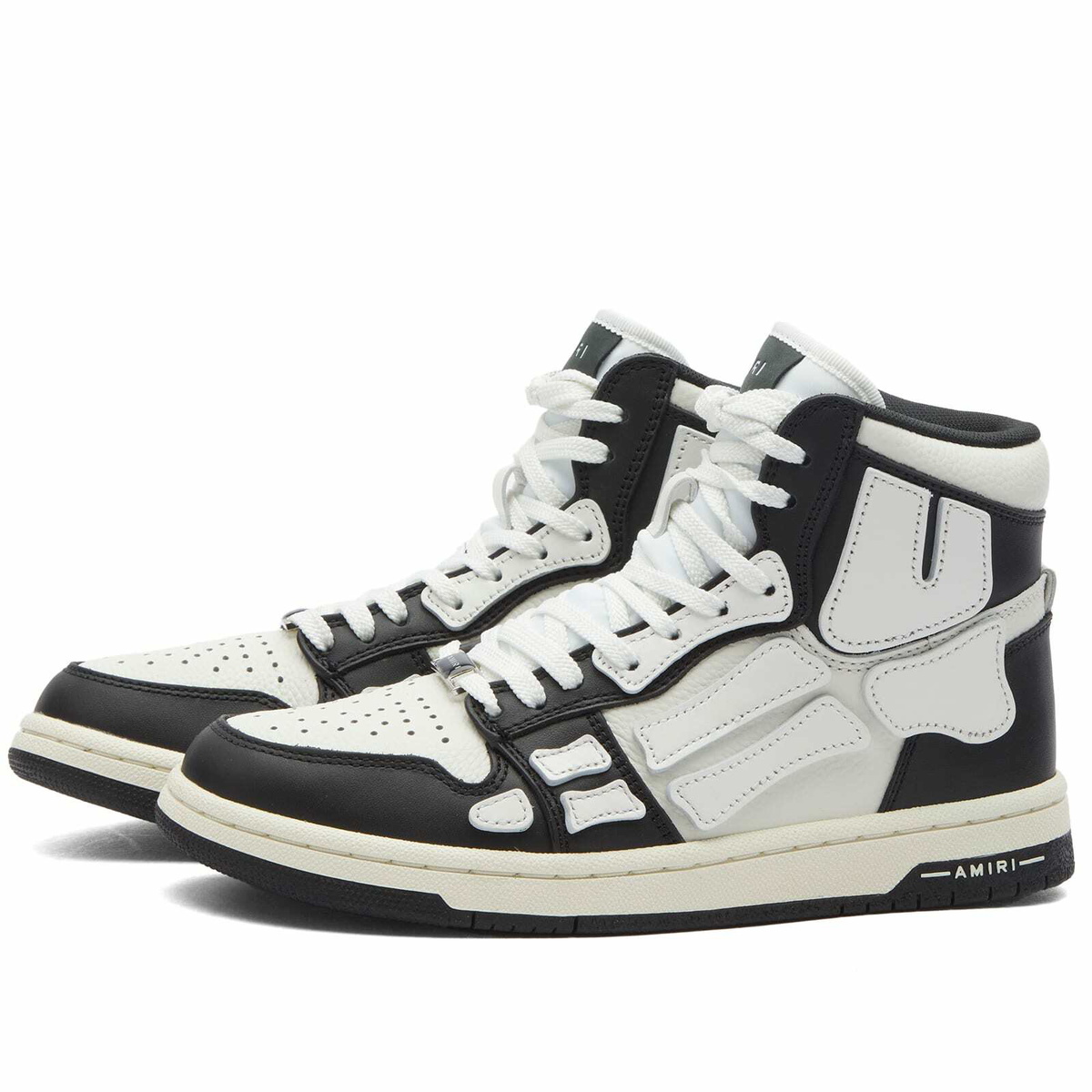
The seasonal work sits mostly in the treatments, and that explains how a single shape reappears looking unrelated to itself. Bandana shows it most clearly: the paisley panel sits in exactly the structural position the leather holds on an MX1. That makes it a substitution rather than an ornament, which is a genuinely different thing from a print. Crystal is an embellishment laid over existing styles, with crystal pieces sitting at the top of the price band wherever they land. Stud, Eagle, Aloha and Monogram operate the same way, turning up on an amiri hoodie or a pair of shorts inside a single season. Product names generally parse from the front as treatment first and fit second.
- MX1 Bandana Jacquard and MX1 International, where pleated bandana print replaces the leather
- Bandana Repair Straight Jean, a full product name in its own right
- Crystal Thrasher, and Crystal Shotgun alongside it
- Stud MX1 and Aloha MX1
- MX2 Bandana and MX2 Plaid Patch, mostly found off-price these days
Observed prices, taken fit by fit
These figures are observed market listings and not an official price list, and they shift. Separate two channels, because they behave differently: the brand’s own full-price retail on one side, and on the other the large multi-brand stockists whose listings carry in-season markdowns. Anyone looking at amiri men in both channels will find the same jean at two very different numbers within one season. Discounting is structural, with reductions of roughly 40 to 70 percent visible in-season at authorised retailers and off-price arms, so any claim that the brand never marks down is wrong. It is that sale floor which caps secondary-market prices too, with standard MX1 pairs changing hands well below full retail. Read the table as a snapshot, and re-check before acting on any single number.
| Cut | Defining detail | Where it sits |
|---|---|---|
| MX1 | Distressed zones with pleated ovine leather set in | Signature, observed $1,090 |
| Stack | An inseam engineered long so it concertinas at the ankle | The entry point, observed $750 |
| Thrasher | Nothing but hand-distressing, without a leather panel | Core band, the broadest distribution |
| Shotgun | Frayed shot-through holes with sanded edges | Core band, straight and skinny |
| MX2 | Knee and outseam zip detailing, with sources in disagreement | Leaning archive |
| Carpenter, Baggy, MA Fit | Roomy modern cuts with workwear detailing | Core through to the upper band |
| Baggy MX3 | Motocross-inspired hybrid, no waistband | In womenswear, observed $990 |
Sizing, care and where each pair is made
Because complete garment measurements are not released for every style, fit guidance is buyer-reported rather than published. Deliberately narrow is how the core skinny cuts run, with waist sizing broadly true to the labelled inch, which leaves the leg as the trouble. Buyers with muscular thighs or calves commonly say they move a size or two one or two sizes to keep a slim line. Long-looking legs on Stack and Shotgun are the stacking inseam doing its job and should not prompt a size change. Care matters more than on ordinary denim, since core pairs warn about intentional shading variation and dye transfer and are spot-clean only, with no washing, bleaching, tumble drying or ironing. Country of origin varies by style, and while MX1 and Stack are made in the USA, the blanket claim that all amiri clothing comes out of Los Angeles is false.